
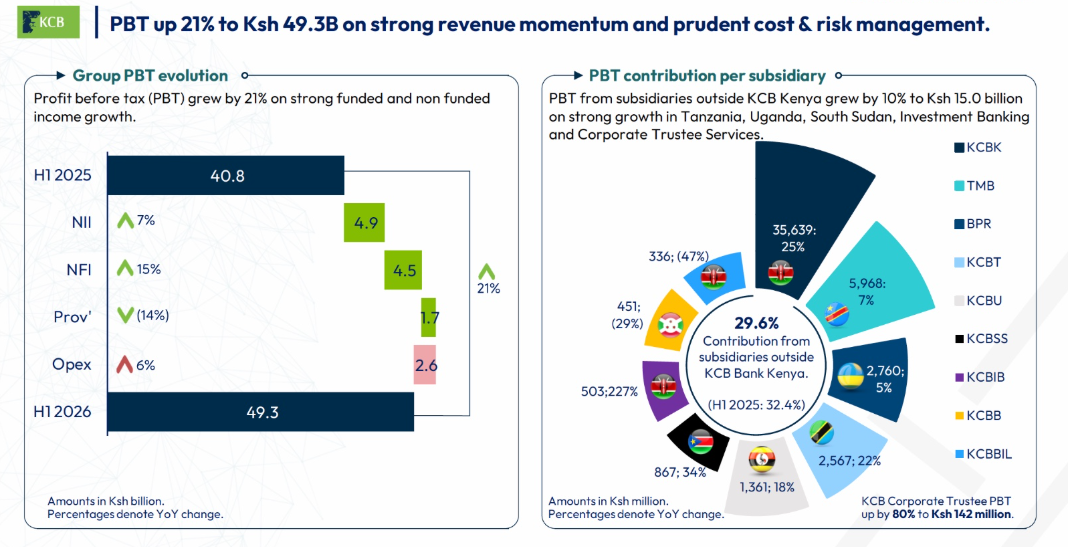
KCB Group PLC reported KShs. 49.3 billion in profit before tax for the first half of 2026, a 20.8% rise, on strong income growth and discipline in cost management.
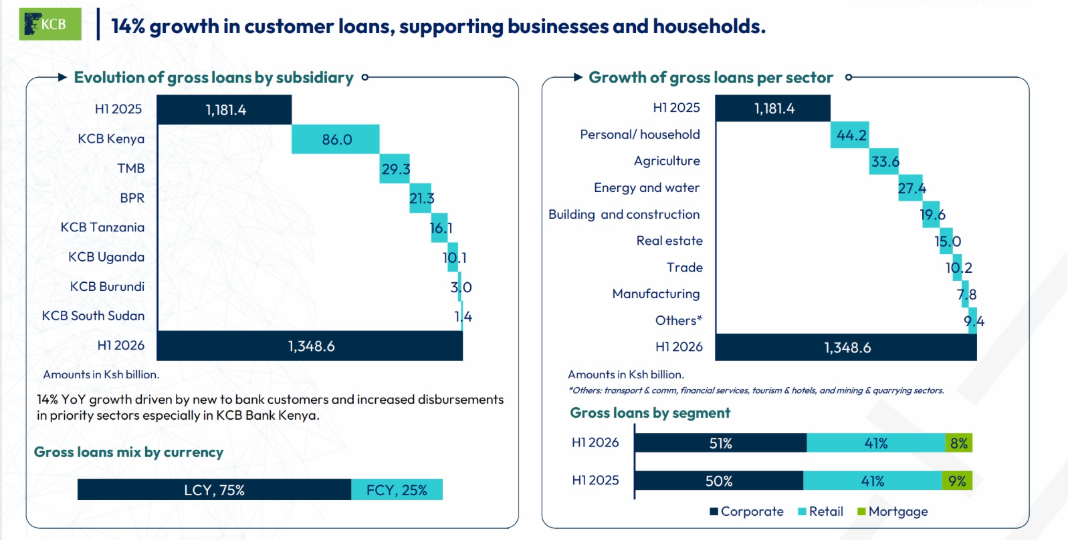
Total assets grew by 16.8% to KShs. 2.3 trillion, driven by a 15.1% increase in customer deposits to KShs. 1.7 trillion and a 14.2% growth in gross loans to KShs. 1.3 trillion supported by a strong corporate and retail franchise.
On the back of the robust business performance, the Board has declared an interim dividend of KShs. 3.00 per share, representing a 50% increase from KShs. 2.00 per share paid last year resulting in a distribution of KShs. 9.64 billion.
This is a commitment to keeping our promise of increasing the dividends payment ratio.
Speaking during the announcement of the results KCB Group CEO, Paul Russo attributed the strong half-year performance to the resilience of its diversified business model, strong regional presence and continued customer confidence.
“Our strong half-year performance reflects the resilience of KCB Group’s diversified business model, the strength of our regional footprint, and the confidence our customers continue to place in us.
He also emphasized the Group’s commitment to supporting businesses and households, advancing digital transformation and delivering sustainable long-term value to shareholders and the communities it serves.
“Despite a tough operating environment, we remain committed to supporting businesses and households, accelerating digital transformation and creating long-term sustainable value for our shareholders and the communities which we serve,” said Russo.
KCB Income Growth Supported by Regional Operations
Total income increased by 9.5% to KShs. 108.1 billion, reflecting sustained growth across the Group’s diversified business operations.
Non-funded income rose by 15.4% to KShs. 34.1 billion, while funded income increased by 7.0% to KShs. 74.0 billion.
Meanwhile, KCB’s regional banking subsidiaries continued to make a significant contribution to performance.
Operations outside KCB Bank Kenya accounted for 27.7% of Group profit before tax and 31.1% of the total balance sheet, underscoring the importance of the Group’s regional footprint.
Read More: KCB Secures $100 Million EBRD Facility to Boost Financing for Women and Youth-Led Businesses
Loan Growth and Improving Asset Quality
On the balance sheet, gross loans increased by 14.2% to KShs. 1.3 trillion, supported by strong acquisition of new-to-bank customers.
The growth was further supported by increased lending to existing customers across the retail, SME and corporate segments.
At the same time, asset quality improved, with gross non-performing loans falling by KShs. 17.3 billion to KShs. 203.8 billion from KShs. 221.1 billion a year earlier.
Consequently, the NPL ratio declined to 15.1% from 18.7%, reflecting proactive rehabilitation of distressed facilities, stronger recoveries and disciplined credit-risk management.
The Group also maintained a healthy funding profile, with the loan-to-deposit ratio improving to 78.8% from 79.5%.
Return on Assets remained stable at 3.3%, while Return on Equity stood at a strong 21.1%, pointing to continued balance-sheet resilience and efficient asset utilisation.
Strong Capital Position Supports Growth
Furthermore, all banking subsidiaries remained well-capitalised and compliant with their respective regulatory capital requirements.
The Group’s Core Capital to Risk-Weighted Assets Ratio stood at 18.6%, well above the statutory minimum of 10.5%.
Meanwhile the Total Capital to Risk-Weighted Assets Ratio was 21.6%, significantly above the regulatory threshold of 14.5%.
These strong capital buffers give the Group capacity to support future business growth, absorb potential shocks, continue financing customers across its markets and sustain its commitment to progressive dividend distributions.
Commenting on the performance, KCB Group Chairman Dr. Joseph Kinyua said the results reflected the effectiveness of the Group’s governance framework and disciplined execution of its long-term strategy.
He added that KCB remained focused on prudent risk management, innovation and sustainable growth while supporting economic development and delivering long-term value to shareholders and other stakeholders across the region.