
Kenya’s shift towards solar power is gathering pace amid growing demand for more affordable and reliable electricity.
For many consumers, solar offers a way to lower power costs, reduce reliance on the national grid and embrace cleaner, renewable energy.
The growing interest is evident among households and commercial enterprises, with many turning to solar to manage rising electricity bills and cushion themselves against frequent power outages.
About 2,000 of Safaricom’s 7,000 base transmission stations are now fully powered by solar energy, while major commercial developments such as Two Rivers Mall have invested in large-scale rooftop solar installations.rooftop solar installations.
This growing adoption of solar comes as Kenya’s electricity access continues to expand.
According to the International Energy Agency (IEA), Kenya’s electricity access rate rose from 37 per cent in 2013 to 79 per cent in 2023, putting the country on a path towards universal electricity access by 2030.
Yet the expansion of the national grid has not reached everyone. Millions of people still depend on off-grid energy solutions, while Kenya has emerged as East Africa’s largest market for off-grid solar.

Kenya’s Growing Solar Footprint
The IEA estimates that the country accounts for nearly 74 per cent of solar home system sales in the region, with one in every five Kenyan households already using standalone solar systems or mini-grids.
For many households, therefore, solar is not simply an alternative to the grid. It can be the most practical way to get reliable electricity where grid connectivity remains limited.
But as more Kenyans embrace solar, another question is becoming increasingly important: are they buying systems that are actually suited to their needs?
Read More: KCB Unveils Sustainability Bond Framework Ahead of KSh300B MTN Programme
Bridging Kenya’s Energy Access Gap
For Gilbert Mugo, the question is rooted in years of experience working with communities that remained beyond the reach of reliable electricity.
Before establishing Keru Solar in 2024, Mugo worked on Kenya’s Last Mile Connectivity Programme, which sought to extend electricity access to households and communities that were underserved by the national grid.
Through World Bank and African Development Bank-funded projects, he was involved in programmes that connected more than 120,000 households across 17 counties.
That experience exposed him to homes and businesses that, despite the country’s progress in expanding electricity access, still struggled to obtain reliable power.
“We realised there were still homes and businesses that couldn’t access reliable electricity,” he said.
The experience eventually influenced his decision to move into renewable energy, where he now focuses on helping customers identify solar systems that match their actual electricity needs.
For Mugo, one of the biggest mistakes consumers make happens before a single solar panel is installed.
The First Step Is Not Buying
Many prospective solar customers begin with a budget.
They may approach an installer and say they have a certain amount of money to spend and want a solar system within that price range.
But according to Mugo, the starting point should be the amount of electricity the household actually needs.
“Many people focus on how much they want to spend instead of how much power they actually need. They come with a fixed budget and ask for a solar system worth a certain amount,” he says.
The better approach is to first assess the household’s electricity consumption. This process, known as system sizing which determines the appropriate combination of solar panels, batteries and inverters based on the customer’s energy demand.
In simple terms, the system should be designed around the appliances a household uses, how much power those appliances consume and how long they are expected to run.
An undersized system may fail to provide enough electricity, particularly when demand is high or during periods of limited sunshine.
An oversized system, on the other hand, can leave a homeowner paying for generating and storage capacity that may never be fully utilised.
Getting the sizing right, therefore, can make the difference between a solar installation that reliably meets a household’s needs and one that becomes a source of frustration and additional expense.
Falling Prices Should Not Mean Compromising on Quality
The economics of solar have also changed significantly.
According to the IEA, equipment prices have fallen considerably over the past decade, helping make solar technology more affordable and contributing to its wider adoption in Kenya and other emerging markets.
Lower prices have opened the technology to more households, but Mugo warns consumers against equating affordability with quality.
“Another mistake customers make is not engaging qualified installers or technicians. What I would call a tier three equipment whose quality is not the best in the market, and what that does is it reduces the lifespan of this system,” he says.
He advises consumers to work with qualified technicians, insist on proper system sizing and choose equipment from reputable manufacturers rather than making decisions based solely on the lowest quotation.
A solar installation is also a long-term investment. According to Mugo, a properly designed and installed system can serve a household for between 20 and 25 years, making the quality of the equipment and installation critical to its overall value.

Powering Communities Beyond the Grid
Kenya’s experience also illustrates why solar remains important even as electricity access through the national grid expands.
Last-mile connectivity programmes have significantly extended the reach of electricity infrastructure, but extending the grid to every household and business can be challenging, particularly in remote or sparsely populated areas.
Off-grid solar systems and mini-grids can help bridge some of these gaps by providing electricity without requiring every customer to wait for a conventional grid connection.
For households in such areas, the decision is not necessarily between grid electricity and solar.
In some cases, solar may provide the most immediate and practical route to reliable power.
As Kenya pushes towards universal electricity access, these technologies could therefore complement grid expansion rather than compete with it.
The Solar Decision Starts Before Installation
Kenya’s growing solar market presents consumers with more choices and, increasingly, more affordable options.
But having more choices also makes it important for buyers to understand what they are paying for.
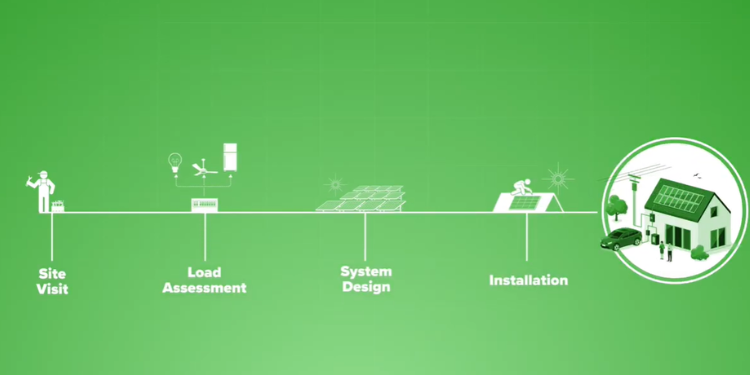
For Mugo, the fundamental principle is straightforward: start with the customer’s energy needs, not the customer’s budget.
“Sizing is understanding the power requirements of this client, analyzing their loads so that we get to understand the size of system that the client needs,” he says.
Ultimately, the success of a solar installation is not determined simply by how many panels are on a roof or how much was spent on the system.
It depends on whether the equipment, capacity and installation are appropriate for the household or business using it.
As solar becomes an increasingly important part of Kenya’s energy landscape, making the right choice could matter just as much as making the switch.