
The Kenya Commercial Bank (KCB) has issued letters of credit worth more than KShs. 1.074 trillion under the Government-to-Government (G-to-G) fuel importation programme.
Through the programme, the Bank has supported Kenya’s energy security by facilitating a steady supply of petroleum products to industries, businesses and households.
In doing so, it has highlighted the growing role of financial institutions in strengthening energy resilience by providing the financing needed to sustain fuel supply chains during periods of global uncertainty.
Speaking during the Petroleum Institute of East Africa (PIEA) Q2 Industry Presentation, KCB Kenya Director, Corporate Banking, Peter Ng’eno, said the Bank’s commitment to the energy sector was most evident during Kenya’s fuel financing challenges in 2022.
“Our commitment to the industry was perhaps most evident in 2022 when Kenya faced one of the most significant energy financing challenges in recent history. As pressure mounted on fuel imports and foreign exchange demand intensified, the Government sought a financial partner capable of supporting a new importation framework that would stabilize fuel supply while easing pressure on the country’s foreign exchange reserves.” Ng’eno said.
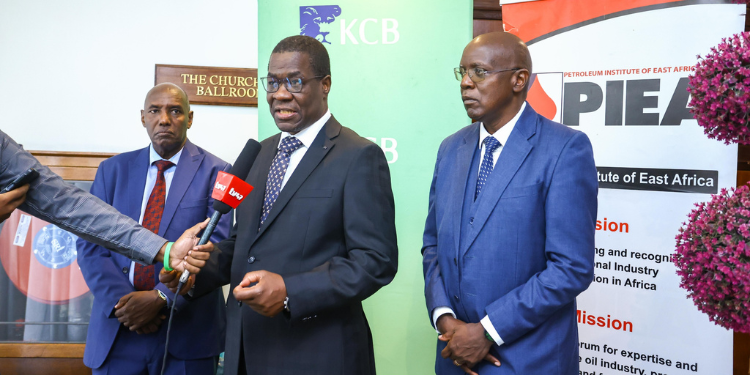
He added that KCB was well positioned to support the initiative, mobilizing the necessary resources needed to operationalize the framework.
“KCB was ready to answer that call. We stepped forward as the primary financial partner under the Government-to-Government (G-to-G) fuel importation programme, mobilizing our expertise, capital strength and international banking relationships to operationalize the framework.” Peter added.
More Than Financing: Strengthening Energy Resilience
Ng’eno noted that KCB’s experience supporting the G-to-G fuel importation programme has reinforced the close link between financial resilience and energy security.
He said this is particularly important at a time when global markets continue to face geopolitical tensions, supply chain disruptions and foreign exchange volatility.
In addition, he observed that beyond physical infrastructure, reliable financing mechanisms are critical to maintaining supply chains, managing risk and ensuring continuity during periods of disruption.
According to him, the experience demonstrates that financial institutions have become indispensable partners in safeguarding national and regional energy security by enabling reliable access to strategic commodities.
Read More: Airtel Money Customers to Deposit, Withdraw Cash at KCB Agents in New Partnership
Over a Century Supporting the Energy Value Chain
KCB’s contribution to the energy sector is rooted in more than 130 years of experience supporting businesses.
Peter noted that the Bank’s long-standing presence has enabled it to support players at every stage of the oil and gas value chain.
“For more than 130 years, KCB has established itself as a trusted financial partner across the oil and gas value chain.” Ng’eno mentioned.
The Bank has supported upstream exploration and production, financed midstream infrastructure and logistics.
Equally, it partnered with downstream petroleum marketers, distributors, transporters and service providers to ensure reliable energy supply across the region.
Responding to a Changing Global Energy Landscape
According to Ng’eno, geopolitical tensions, supply chain disruptions, foreign exchange volatility, inflationary pressures and the accelerating transition to cleaner energy continue to reshape global markets.
He said these global pressures are particularly relevant for East Africa, where rapid population growth, urbanisation and expanding industrial activity are creating significant economic opportunities while placing increasing demands on the region’s energy systems.
The director noted that the challenge now extends beyond securing adequate fuel supplies to building systems capable of anticipating disruption, absorbing shocks and maintaining reliable energy access.
He added that stronger collaboration among governments, industry and financial institutions will be essential to enhancing energy resilience.

Lessons from Recent Global Disruptions
KCB noted the recent tensions in the Middle East exposed the continued vulnerability of global energy markets.
The bank said, disruptions along key shipping routes quickly translate into higher freight costs, increased insurance premiums, greater foreign exchange demand and elevated working capital requirements.
Financing the Energy Transition
KCB emphasized that energy security and sustainability should be pursued as complementary priorities to support Africa’s industrialisation and long-term economic competitiveness.
The Bank noted that achieving this balance will require a diverse energy mix, supported by increased investment in renewable energy and cleaner technologies.
It added its commitment to continue developing innovative financing structures to support the next generation of energy investments.
KCB noted that today’s financing decisions will help determine the resilience of tomorrow’s energy systems.
Building the Future Through Partnership
In conclusion, Ng’eno said the future of East Africa’s energy sector will depend on stronger collaboration among governments, industry players and financial institutions.
He called on governments to create enabling policy environments and urged industry players to continue investing in innovation.
He added that financial institutions have a critical role to play by providing the capital needed to turn ambition into sustainable growth.
Ng’eno reaffirmed KCB’s commitment to partnering with the Petroleum Institute of East Africa and the Ministry of Energy and Petroleum to help build a secure, resilient and sustainable energy ecosystem.
He added that this collaboration aims to support inclusive economic growth for generations to come.